

News

|
服务热线 000 |

|
联系电话 000 |

|
电子邮箱 000 |
Agrochemical Encyclopedia
Potato high yield fertilization
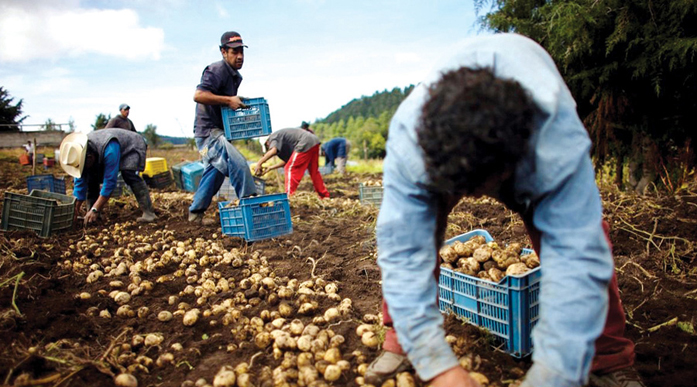
Potato, also known as potato, is a high-starch tuber crop. Its growth period is divided into seedling stage, tuber formation and growth stage, and starch accumulation stage. During the entire growth period, potatoes absorb the most potassium fertilizer, followed by nitrogen fertilizer, and the least phosphorus fertilizer. Different growth periods have different characteristics in terms of nutrient needs. In the seedling stage, since the tubers are rich in nutrients, less nutrients are required, accounting for about 1/4 of the entire growth period. During the tuber formation and growth period, the growth of the aboveground stems and leaves and the expansion of the tubers proceed simultaneously, requiring more fertilizer, accounting for about 1/2 of the total fertilizer requirement. During the starch accumulation period, less nutrients are required, accounting for about 1/4 of the entire growth period. It can be seen that sufficient nutrient supply during the tuber formation and growth period plays an important role in increasing potato yield and starch content.
Potatoes have strong adaptability to growth and can be planted all over the country. The general growth period is 90-110 days. For every 1,000 kg of potato produced, 3.5-5.5 kg of nitrogen, 2.0-2.2 kg of phosphorus (P2O5), and 10.6-12.0 kg of potassium (K2O) need to be absorbed. The ratio of N: P2O5: K2O is 4.5:2.1:11.3, or 1:0.5:2. If 1,500 kg of potato is produced per mu, the average nitrogen, phosphorus, and potassium absorption is 7, 3, and 17 kg. Nitrogen can promote the growth of stems and leaves and the accumulation of tuber starch and protein. Phosphorus promotes plant growth and robustness, improves tuber quality and storage resistance, and increases starch content and yield. Potassium promotes the accumulation of tuber starch in the late stage of potato growth and enhances the plant's disease resistance and cold resistance. In addition, potatoes are sensitive to boron and zinc. Boron is beneficial to the expansion of tubers, prevents cracking, and has a special effect on improving the net photosynthetic productivity of plants. The fertilization technology of potatoes should follow the principle of mainly using farmyard manure, supplemented by chemical fertilizers, mainly using base fertilizer, and appropriate topdressing. Apply base fertilizer heavily. Potatoes are tuber crops that prefer loose sandy soil and require a cool climate. The amount of base fertilizer generally accounts for more than 2/3 of the total amount of fertilizer. The base fertilizer is mainly fully decomposed farmyard manure, and a certain amount of chemical fertilizers, especially phosphorus and potassium fertilizers, are added as base fertilizers. This can improve the physical properties of the soil and is conducive to growth and tuber formation. The amount of nitrogen fertilizer in the base fertilizer accounts for about 50%. The method of applying the base fertilizer is to apply it in furrows or holes before planting, about 15 cm deep. The specific amount of fertilizer is 1500-2500 kg of organic fertilizer, 20 kg of urea, 20-30 kg of calcium, 10-12 kg of potassium fertilizer, or 40-60 kg of high-nitrogen and high-potassium compound fertilizer per mu for a plot with an output of about 1500 kg per mu. The amount of fertilizer applied in high-yield areas can be appropriately increased. Chemical fertilizers should be applied 2-3 cm away from the seed potatoes to avoid direct contact with the seed potatoes, and covered with soil after fertilization. Topdressing should be applied early. Topdressing should be reasonably applied in combination with the potato growth period. Nitrogen fertilizer should be applied during the seedling stage, and 5-8 kg of urea per mu can be used for watering in combination with inter-cultivation and soil cultivation, which is conducive to seedling protection. After the potatoes bloom, root topdressing is generally not carried out, especially nitrogen fertilizer. After the potatoes bloom, phosphorus and potassium fertilizers are mainly sprayed on the leaves. 50 kg of 0.3-0.5% potassium dihydrogen phosphate solution is sprayed on the leaves per mu. If nitrogen is deficient, 100-150 grams of urea can be added. Spray once every 10-15 days, and spray 2-3 times in a row. Potatoes are sensitive to boron and zinc. If the soil lacks boron or zinc, 0.1-0.3% borax or zinc sulfate can be sprayed on the roots. Generally, it is sprayed once every 7 days, and sprayed twice in a row. 50-70 kg of solution per mu can be used. Farmers should be reminded that potatoes are potassium-loving crops, and special attention should be paid to the application of potassium fertilizers in balanced fertilization. At the same time, it is not advisable to apply too much chlorine-containing fertilizers, such as potassium chloride, and potassium sulfate should be used, otherwise it will affect the quality of potatoes.


